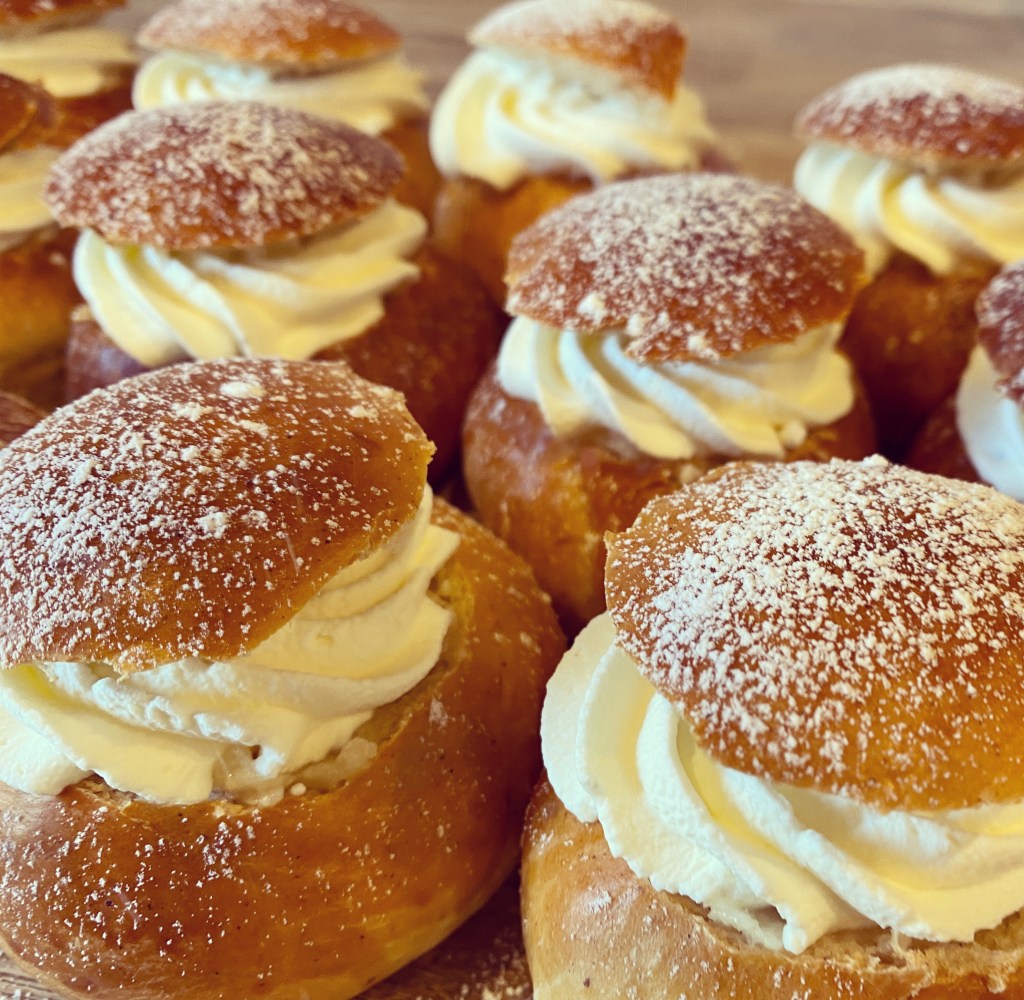
While the majority of the Christian world concluded the day before Lent should be spent on “Shrove”, or confessing one’s sins – while also better make some pancakes to finish up all that fresh milk and eggs before the fasting season, the Nordic people had a different idea. How to better prepare for lent than indulging in the most decadent, sugary and creamy fika one could imagine.
Enriched (yes add in the milk and eggs to use those up), cardamom spiced brioche, filled with almond paste and fresh whipped cream, powdered with confectioner’s sugar: the Semla was created.
Why stop at pancakes when we can make the entire day a Fat Tuesday!
It’s been almost a year since I collapsed and was rushed to A&E following a complete burn-out, physically and mentally, after years of stressing through an unsustainable lifestyle. I was trying to raise three young children while working full-time at a demanding job. Although I loved my work (designing skyscrapers) and my colleagues, my clients and the consultant teams – no work was ever good enough. I often thought I’d better quit this job, but I worried I might cease to exist if I did. Until that day, about a year ago, when my body revolted against my twisted mind, and started turning off my organs.
It would take a few months off work on sick leave to gather the courage to make a life-changing decision. My boss hadn’t got in touch asking how I was doing. As my physical pain started to relieve, it dawned on me what madness I’d been involved in. Without too much thought, I wrote a resignation email and sent it off. The practicalities were resolved quickly by HR and just like that, what had been my life, love and often all that ever mattered to me, was gone. The stressors that had nearly killed me vanished. At least seemingly.
The healing of the mind will take some time. I oscillate between states of euphoria from not having to enter another day in a destructive environment, and a sense of loss – of identity and of having a clear place and purpose in the world. I’m often tired, sighing out the constant processing of the mind, recovering from night tremors, or dodging ghosts lurking in the corners.
“What now”, I’ve asked myself for months on end. The empty patches quickly fill up with other things. But while there are things to do, one moment at a time, just this moment, this day, there are still things that need to go. Patterns of the mind, thoughts that aren’t helpful, that hurt. Keep stripping back, sigh it out, shrug it off. Until all that’s left is where I must start: Loving kindness – in this very moment. Respect and love oneself. Be kind to oneself. So I can love others.
I have spent a year actively trying to be Grey. Trying to avoid the polarised extremes of existence: All or Nothing, High or Low, On or Off, One or Other, Black or White.
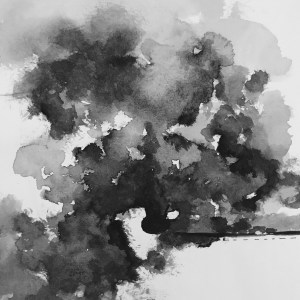
The space between those poles must be vast. Like tangents on a curve, an almost infinite entirety of mediations; a plain of moderation, a mist of understandning, a lifting dew of balance, all across ever so slight variational shades of Grey.
Yet, that supposedly vast space seems profoundly hard to find. Rather than an endless landscape, it appears to be hiding somewhere in that flickering buzzing moment when slowly turning a lightswitch. Ungraspable. Or, as if trying to force a computer down a non-binary alley to explore the worlds lurking between zero and one.
In short moments of entering the glorious and peaceful Grey mist, gracefully lifting and clearing the view with the weightless dew, I have instantly found myself falling, tumbling round, lost in a rather heavy fog. Then, with the strong gravitational force of the poles, been pulled back to either side, outside the Grey.
Something is turning Blue. Is it the yearning for Grey? Or the realisation that Grey is so difficult? Or is Grey itself Blue? Is Mediation actually Melancholy? My world of Grey is out of reach. All I see is Blue.
Perhaps Grey is indeed an unattainable field, in terms of pinpointing any fixed space-time positions. Perhaps Grey is in constant motion; a wave pendulum, an oscillating blur between polarised opposites.
Entering such a vibrational space would perhaps be an act of humbling, of not understanding, and of letting go.
An owlet falls down from her nest in her sleep in one of our children’s books. She finds herself in a new world, the world down on the ground. She is not overly scared, just terribly lost.
For years, I felt like I was onboard a speeding train, rushing through a landscape full of people, places and events that I barely acknowledged but only vaguely noticed as a blur through the window. Even if I leaned out to try to get closer, to hear a converstaion better, or to smell or taste the ambiance, my train didn’t have time to stop. It kept rushing fast towards something, somewhere unknown. The train I was onboard had no destination, it’s only incentive was to move faster and to deny the landscape around me, which was my life.
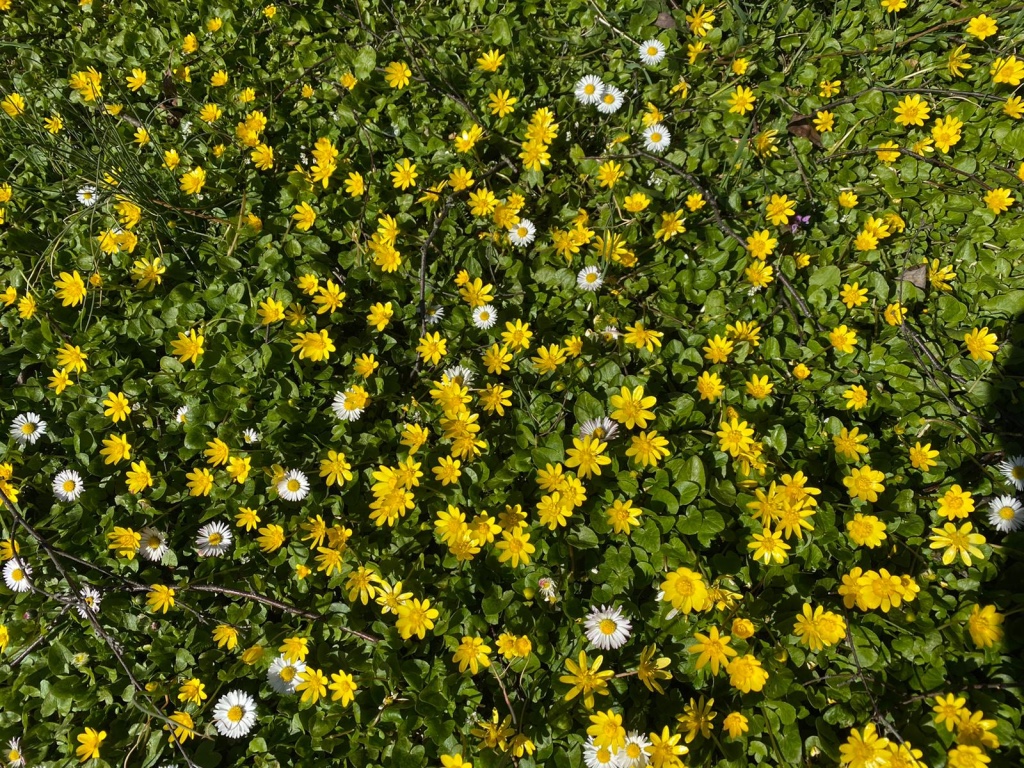
I’m not sure how I got off and landed on a flower lawn. Did I fall off? Did someone push me? Or did I jump? As I looked up in my confusion I could see that the train had rushed on without me.
Lawn
Like the owlet, I wasn’t really scared, just lost.
Months have passed, and now not only I got off the train, everyone did! The trains didn’t rush on, they all stopped and everyone got off. We’re all sitting on our little patches of lawn (typically inside our houses) and look around at our little landscapes surrounding us. Our little universes. Our lives.
The owlet in the story eventually finds her way back up in her nest having made some new friends down on the ground. But as a few trains in my reality are slowly starting to move again, I have little intention of getting back on mine. It was never mine, my nest. And my little lawn is becoming a rather nice place to be. The here and now is pleasant. But when looking up from that daydreaming patch, the question waiting around every corner is inevitable: What’s next?
The next hour, the next month, the next year?
It seems such a great opportunity to make a radical change, get out of that unhealthy lifestyle, make a difference to others and the planet, enjoy being here, being human. But falling back to the old patterns, the old job (if it still exists), earn money, get on with life, is the so much easier option. Breaking patterns is hard. Leaping into the unknown is scary.
How much of that Scandi pale pine and rustic sourdough can we take in our feeds? Hasn’t that trend passed yet? Well, it may be a passing trend for some, but I have a feeling it will stick with me for quite a while.
Scandi. My ancestors trace back several hundred years to a region not bigger than a few square miles, hidden deep in the darkest of Scandinavian pine forests. It’s a bit of a miracle I actually made it out of there… I used to hate pine and all that soft pale wood. Now I find the rich scent of sticky sap from those tall, rather anti-social needle beasts warming and comforting. I may have left Scandinavia many years ago but, as I acknowledge more and more, my heritage is deeply rooted within me with no intention of leaving.
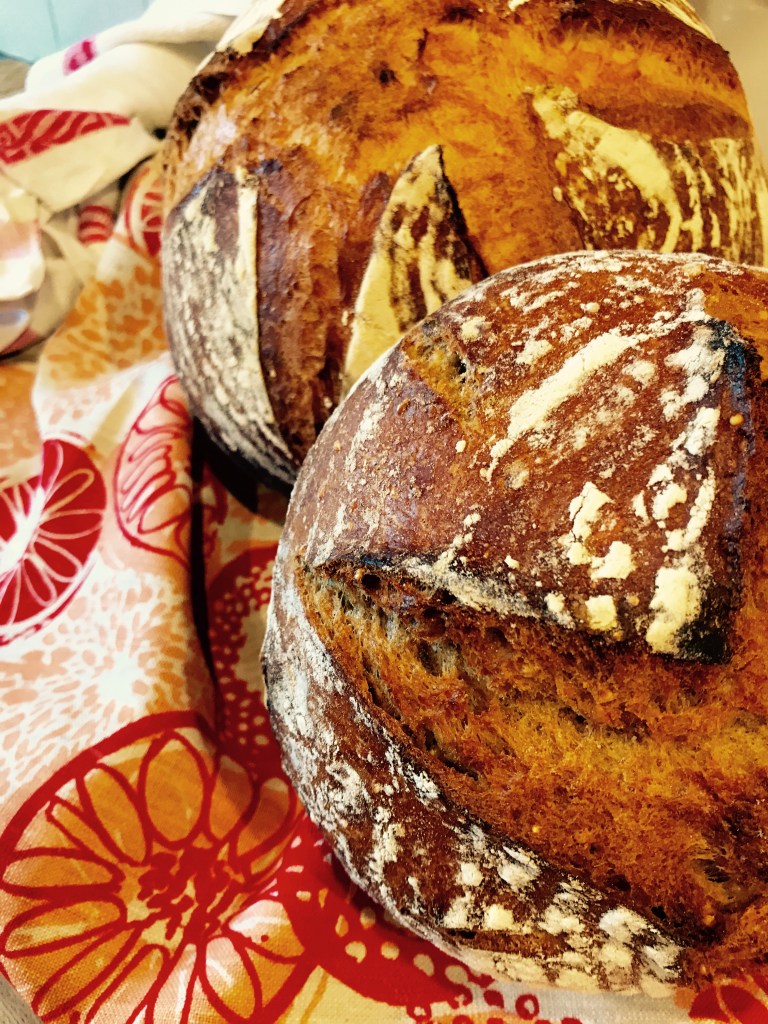
Sourdough. Traditional British bread is sadly inedible to me and many fellow immigrants. Factory-produced squashy white sponges – with the only distinction from a dish cloth being it’s injected with sugar and chemical preservatives – should really not be allowed to be called bread. I often wonder if these sugary sponges have even been baked in any sort of oven as they lack crust and can easily be consumed without using teeth. Sometimes they go under names like “wholemeal”, or “brown” but with little or no change in taste, consistency or nutritional value. Unless you happen to live near a gentrified high street full of artisan bakeries selling hugely overpriced “genuine bread”, you simply have to make your own. Under current pandemic there is no yeast available (because nobody ever liked the bread on the supermarket shelves and now finally have found the time to bake their own, and added yeast to their stockpiling list??) and we are left with only one option for having true bread: Sourdough. It’s not artisan, hippie, hyper or cool – it’s just damn good bread.
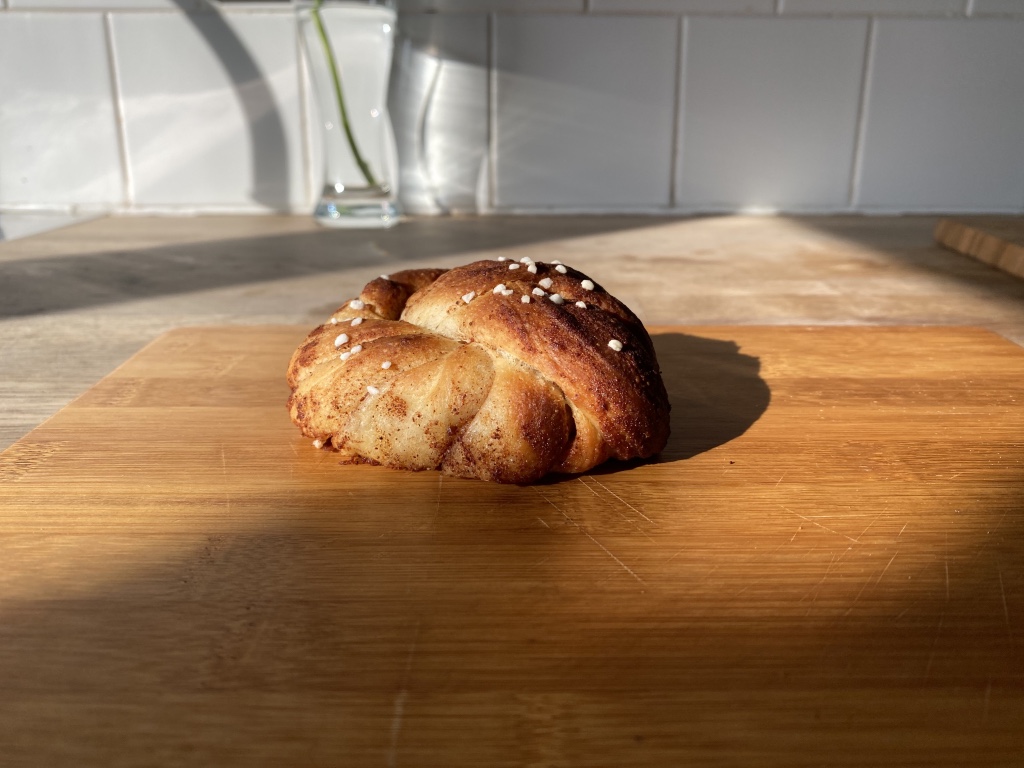
Kanelbulle. Now, the cinnamon bun. Certain drivers within me raise a nostalgic desire to sometimes celebrate “Scandi fika”: Coffee and Bulle, and with the current lack of yeast, I experiment with my sourdough (which almost starved to death last week due to the lack of flour but was rescued by a baker supplier’s 16kg flour delivery…) It works, and as I learn about it, it is in no sense new.
We’re over four weeks in and we appear to have several more weeks ahead of being prisoners in our homes. The coronavirus pandemic is the most globally overwhelming and devastating event in generations, and here we are, right in the midst of it. Trying to cope, trying to stay normal, trying to avoid infection. It’s mind-blowing, at so many levels.
Grey Cloud
One of all the remarkable notes to make is how most of us not only obey but also deeply believe in the authorities guiding us through this. Each country and subsequent pandemic authority (typically the local government together with their set of health/epidemology experts) has gone down different routes in how to handle the disaster, and everywhere to a large extent people appear to truly trust the advice/recommendations/instructions given (with some exceptions of course). From military enforced curfews on the one extreme, via different views on face mask worn in public, light or severe restrictions on gatherings and travel, all the way to countries like Sweden, who doesn’t think this is anything to make a big fuss about at all… and everyone there seemingly accepting that, and believing it and defending it. In Sweden, schools are open, along with shops, restaurants and bars. People go to work and their many different activities, and although life has changed for some, and some businesses are struggling, life pretty much goes on as normal. The death rate per capita appears to be about the same as in the UK. How can that be? And why is nobody questioning the different strategies more?
Is it cultural?
In Spain, one doctor was so upset about the thousands of elderly dying unnecessarily due to the lack of ventilators, he used the word genocide to describe the situation and reminded us that these people have built the country – should we really let them down at the end of their lives? Spanish authorities are doing what they can to stop the spread and save lives by enforced lockdown for weeks on end, to a huge cost to future generations and the economy. Meanwhile, in Sweden, democracy as ideology is so strong and powerful that it is inscribed in the law that nobody can instruct the people what to do. A law not easily modified. And with a population generally known for being pragmatic and rational, it’s also not incorrect or offensive to state that elderly and vulnerable people will die each year anyways due to seasonal flu – and a country can’t shut down only to perhaps save a few of them… It is also in Sweden highly correct to mention that the mental wellbeing of future generations along with economic stability is what’s important at this time.
I’m totally puzzled by these extreme differences in approach, attitude, and trust. And of course the death rates. I don’t get it. Only time will tell this curse’s outcome in our different societies. My initial anger and frustration over democratic/ignorance vs. autocratic/over-reaction has calmed down to a passive surrendering trust in my authorities. They say: “Stay in your house, even if it will drive you and everyone around you absolutely mad. Let’s start with a few weeks, and we’ll think about whether to extend that for weeks longer or maybe months, just enough for everyone to lose their jobs and sanity.” And I obey. I stay in.
Regarding the impact on mental health, I can see the arguments against lockdown clearly making sense. You’re trapped inside with all the potential friction applied in that confined space and defined set of relationships; any normal self-fulfillment is on hold, and worries about finance and health can be overpowering. But if I scrutinize my inner self, and if I try to gauge what’s actually going on deep inside the souls of fellow lockdowners, I secretly wonder if this is the break we have all needed.
Stop the race against time, age, beauty, careers, missed trains, missed lunch, late pickup, and whoever won last week’s bragging about seeing their children the least!
Just breathe..
Pause.
Not knowing when it will all pick up again. Is actually a blessing. There’s nothing in the calendar, everything is on hold. I’m now locked in with three young children, partner and pet. At the end of each one of these crazy days living on top of each other I find it almost a miracle everyone is still alive. But equally, the time we now spend together as a family is a miracle in itself. There may be friction, but at least we’re together. In it together.
As of my civil duty, andremarkably also as of trust in my local authorities, I respect andbelieve in the current lockdown to do what we can to save lives. I will seize this unique opportunity to let one part of me go mad while the other will do the only thing there is to do – just be.
A time full of love, joy and cosyness. Full of stress, anxiety and family conflicts.
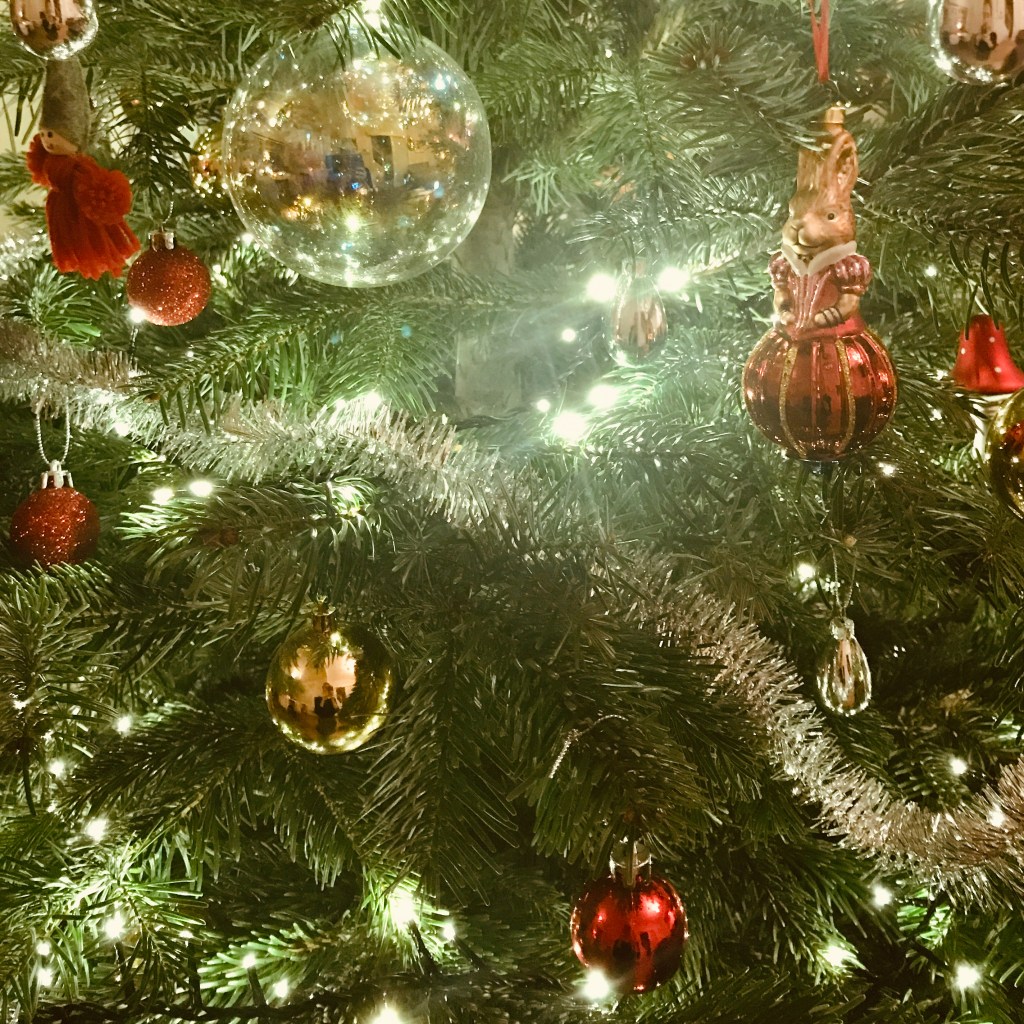
Every year, I turn into this intolerable double-headed Christmas freak, on the one hand wanting everything to be as it was when I was little, but then on the other hand trying my very best to do all but just that, and creating “our own very amazing traditions”.
It is as if this time of year justifies types of behaviour that at any other time would appear completely intolerable, and because it’s Christmas it’s not only alright, it’s what’s expected. It is what makes Christmas.
Being anal about a certain piece of Christmas decoration that everyone hates, but that needs to go onto the tree because it has always been there every year. Or even more bizarrely; putting on that type of argument about a random piece of decoration to our (only a few years old) Christmas tradition, because that type of behaviour and argument is what’s expected at Christmas. That is truly Christmas. And we savour it.
Why?
Progressive, forward-thinking individuals, struck as if hypnotised by the power of nostalgia. Once a year, every year.
So, all of these years in academia and beyond; researching, exploring and elaborating around concepts of dualism, multiplicity, quantum physics and coexistence – I have fundamentally denied my own Other, my Shadow.
In her small conversation room, furnished with only two big armchairs, a side table with mansize tissues and seemingly inappropriate posters plastering the walls, my newly appointed therapist introduced me to Shadow.
I was speechless for several minutes, shocked by my ignorance and obtuseness. How could I have missed that? Of course I know of my rather judgemental conscience, which houses a part of my brain and infiltrates my thoughts, behaviour and actions. But this Shadow.., is something else. It has fought for attention for so long, it has now externalised away from my body into an observer, not only owning but also controlling my conscience. It’s haunting me.
I look over my shoulder as if to acknowledge it’s existence. Where are you? How can I get to know you? Can we make peace?
It appears to me, that even the most opinionated individuals, at a late stage in life, would all of a sudden let out a “well, there are many ways to look at it”, or “that doesn’t bother me very much”, over things that I would have thought a long life would certainly made one form a strong opinion about. I shocks me in a way, disappoints me in another, but it also humbles me to think of what exposure to life – knowledge, experience and numerous human encounters – does to a person.
As a child, life is rather black and white; we learn about our world, what is right and wrong, good and bad. We start building up confidence and knowledge enabling us to ascertain our positions and opinions that on the one hand make us belong in a group and on the other form us into unique individuals.
Grey Cloud
But, paradoxically, the more we learn about our world, the more complex it turns out to be. The more people we meet, and the more we learn about the differences we inhabit, the more we realise that those previously so clearly defined black and white outlines start to blur around the edges.
As we grow older, not only does our hair colour shift to become grey – our understanding of our world appears to make a similar shift.
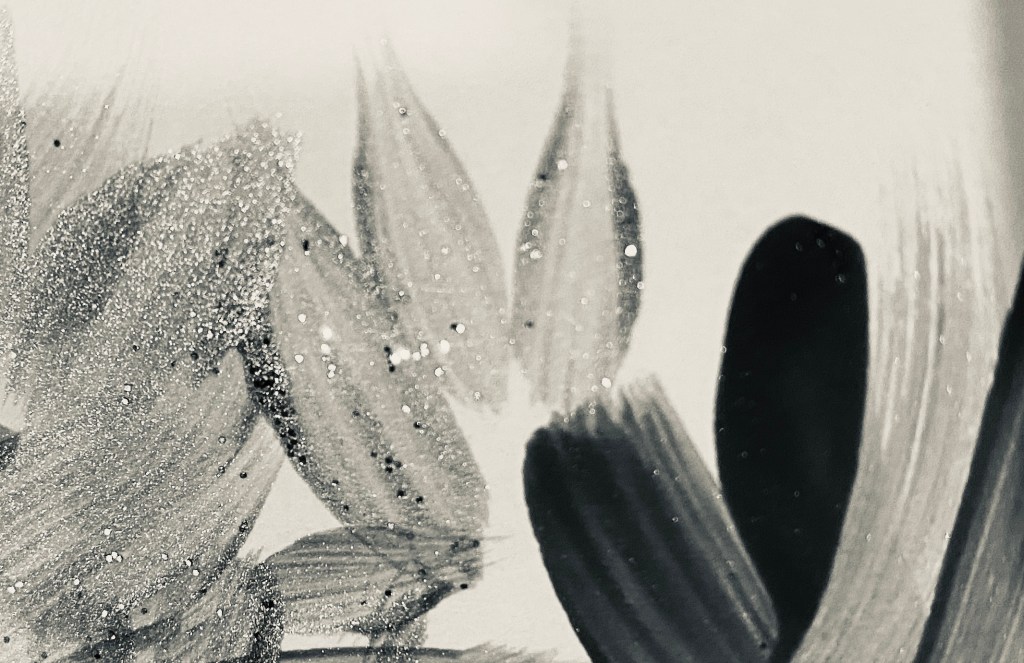
But there is an important subtlety here: Looking closely, the understanding isn’t really grey, that would make us into mushy nihilists. The definition of grey is rather filtered than blurred. In a black and white world, in a room defined by a big window, there’s a blackout curtain either fully open or fully closed, making the room either strikingly bright or completely dark. A mushy nihilistic room would replace the blackout curtain with a net curtain, making the room sleepy and without contrast, covered in a solid almost tangibly measurable grey film. If you would instead use venetian blinds to filter the light, the room would have darkness and light coexisting in the same space with sharp contrasts between the two, constantly changing depending on what goes on outside the window and inside the room. Greyness becomes the intangible ever-changing subjective interpretation between black and white. Greyness, allowing sharp opinion in a humble understanding of the full spectrum.
Of course I love my sourdough starter, anyting else would be absurd. I have bred it from scratch, fed and nurtured it for months on end! I have seen it grow and shrink, I have been there with it through stages of happily bubbling away in healthy well-balanced yeast-bacteria heaven, to moments of neglect, barely surviving, suffocating under growing fluff of not so healthy micro-organisms intending to take over the cosy jar. And it has brought my family superior loaves of bread every week. Of course I love it. It’s like a member of our family. I am one of those weird people who has joined the sourdough cult and who keeps this bacteria pet in a rather disguisting glass jar in the fridge; who asks their friends to leaven-sit when going off on holiday, with strict instructions left on the counter; who has almost gone as far as to naming it (but who would never go as far as to call it “Mother”); and who has become so strangely attached to it, that it manages to connect to the guilt part of my conscience to wake me up at night, reminding me that I forgot to feed it – again!

 Form&Fika